
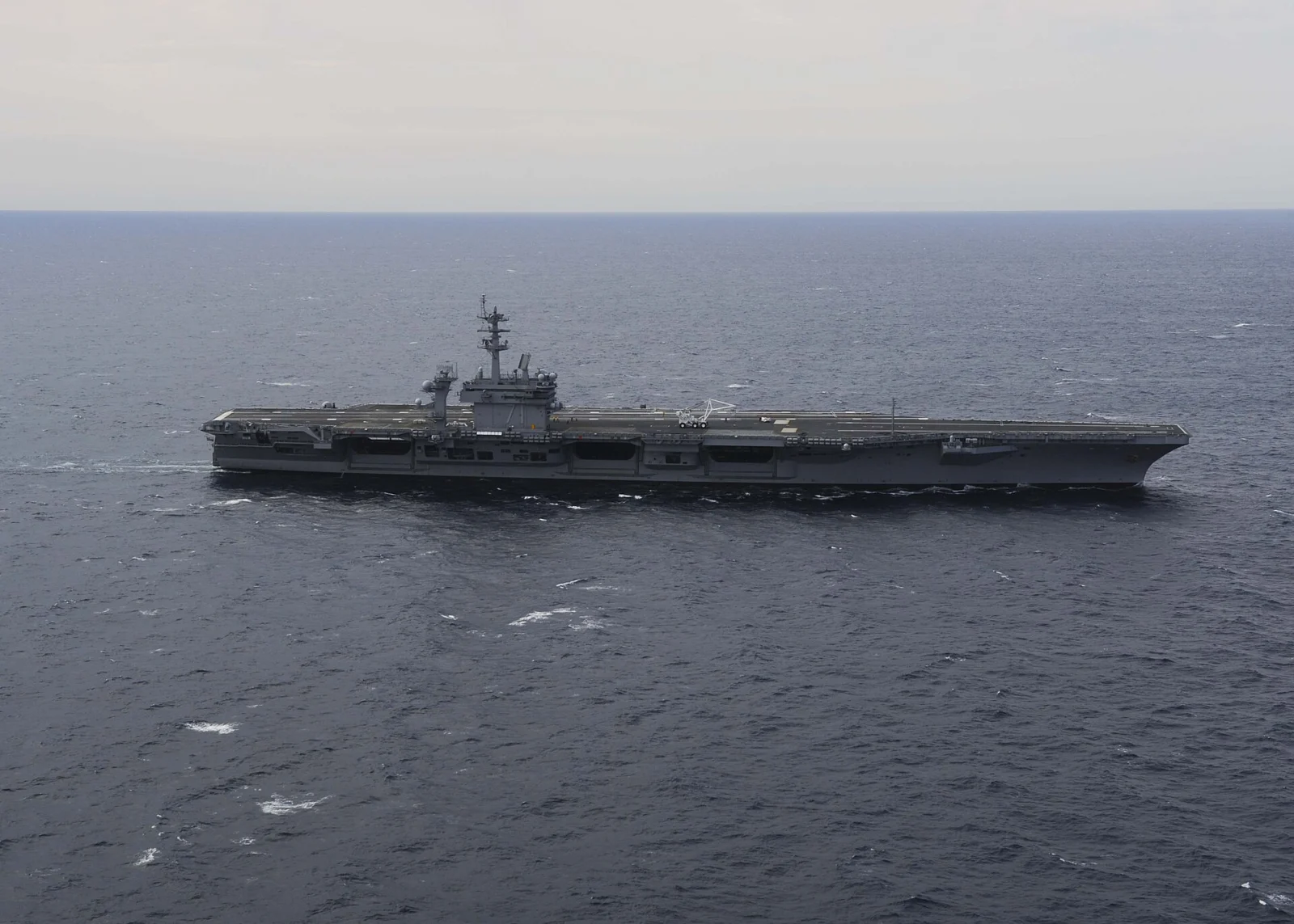
The US aircraft carrier USS Theodore Roosevelt arrived in the Middle East on Sunday, 15 November. According to a report by the US news outlet Axios citing an American official, its arrival raises the number of US carrier strike groups in the region to three.
Middle East Monitor reported that the Nimitz-class warship entered the area of responsibility of US Central Command (CENTCOM), which oversees military operations across the Middle East. The ship left Singapore earlier this month and transited the Strait of Malacca. The New York Times had reported earlier on Sunday that the vessel was expected to reach the Middle East within a day.
Built by Northrop Grumman in Virginia and in service for 40 years, USS Theodore Roosevelt is the flagship of Carrier Strike Group 9. It began its current deployment on 27 September.
The Roosevelt joins two other US carriers operating mainly in the Arabian Sea. USS George H.W. Bush has been in the region on an extended deployment since April as part of Carrier Strike Group 10. USS George Washington, normally forward-deployed to Japan, has been operating in the same waters with Carrier Air Wing 5 since August.
The report has not been officially confirmed. Neither the US 5th Fleet nor CENTCOM responded to a request for confirmation from Anadolu Agency, according to the report.
Background
The naval build-up comes during the ongoing Iran war, which began with coordinated US-Israeli strikes in late February, and at a time when diplomatic efforts between Washington and Tehran have stalled. US President Donald Trump recently removed Vice President JD Vance from peace talks and declared on social media that Washington no longer needs an agreement with Iran.
USS George Washington was sent from the Pacific to the Middle East in August to replace USS Abraham Lincoln, which had been deployed in the region for a long period.
The US military, meanwhile, recently denied an Israeli media report alleging that it was preparing to resume operations against Iran, dismissing claims of changes in its regional force posture as “pure speculation.”
Why it matters
Three carrier strike groups in the same region show that the United States is increasing its naval and air power against Iran at a moment when talks are deadlocked. Taken together with Trump’s statement that a deal is no longer needed and the military’s denial that it is preparing new operations, the purpose of the build-up remains unclear: it could be deterrence, or the rotation of ships that have been at sea for a long time. Because the report rests on a single official and has not been officially confirmed, it is not yet known how long the ship will stay or how long the three carriers will operate together.
Source: Middle East Monitor · Image: U.S. Navy photo by Mass Communication Specialist 2nd Class Brian G. Reynolds., Public domain