
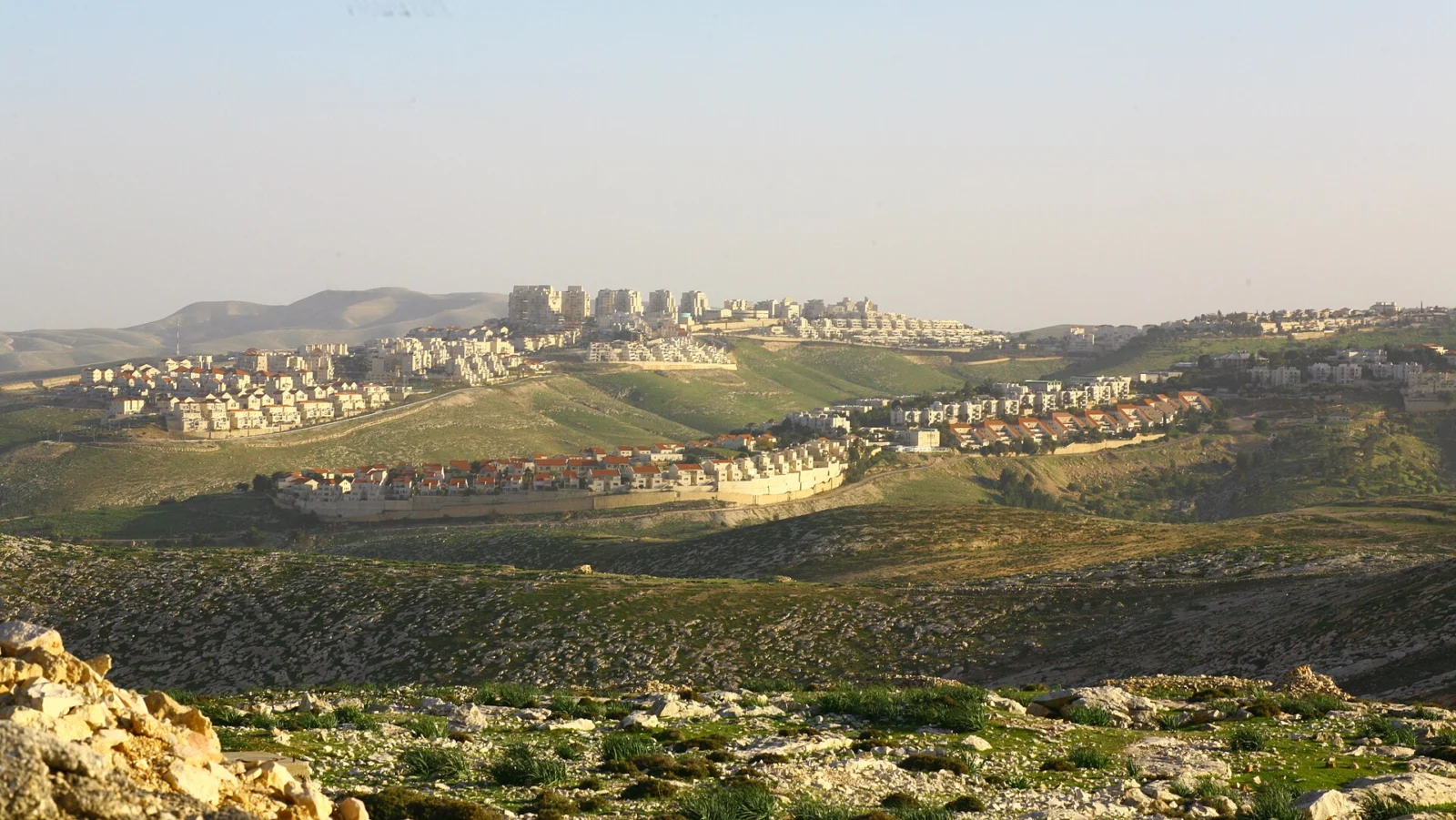
The West Bank is the Palestinian territory west of the Jordan River that Israel has occupied since 1967. The 1995 Oslo II Accord divided it into three zones called Areas A, B and C; the arrangement was meant to be temporary but has been in force for more than thirty years.
Where is the West Bank?
The West Bank is landlocked. Jordan and the Dead Sea lie to its east; to the north, west and south it is separated from Israel by the Green Line, the 1949 armistice line. Wikipedia gives its area as 5,655 square kilometres and its population as an estimated 2,949,246 in 2021. The name “West Bank” came into use after Jordan annexed the territory in 1950, to distinguish it from Jordanian land east of the river. Israel’s official administrative name is “Judea and Samaria”, a usage that is politically contested.
Who ruled it before 1967?
The area was under Ottoman rule from the 16th century and was part of British Mandatory Palestine from 1920 to 1948. It came under Jordanian control in the 1948 war; only the United Kingdom and Iraq formally recognised the 1950 annexation. Israel captured the West Bank in the Six-Day War of June 1967. Jordan relinquished its claim in 1988.
How did Areas A, B and C come about?
The areas were created by Oslo II, officially the Interim Agreement on the West Bank and the Gaza Strip. It was first signed in Taba, Egypt, on 24 September 1995, and then on 28 September 1995 in Washington by Israeli Prime Minister Yitzhak Rabin and PLO Chairman Yasser Arafat, witnessed by US President Bill Clinton. The transitional period was not to exceed five years, and permanent-status talks were to begin no later than 4 May 1996.
Who holds power in each area?
In Area A the Palestinian Authority has both civil and security control. Nablus, Jenin, Tulkarm, Qalqilya, Ramallah, Bethlehem, Jericho and 80 percent of Hebron fall within it. Israeli citizens are forbidden to enter, but the Israeli army has carried out regular arrest raids in these cities since 2002.
In Area B civil affairs are in Palestinian hands while security is shared with Israel. About 440 Palestinian villages and their surrounding lands are in this area.
In Area C Israel has full civil and security control. All Israeli settlements, apart from those in annexed East Jerusalem, are located there.
How much land is in each area?
The shares vary by year and source. In the first phase in 1995, Area A covered about 3 percent of the West Bank, Area B 23 to 25 percent and Area C 72 to 74 percent. According to 2013 figures from the Israeli human rights group B’Tselem, Area A is about 18 percent, Area B 22 percent and Area C 63 percent; Turkish Wikipedia gives 17, 24 and 59 percent. The 1998 Wye River Memorandum provided for a further 13 percent of Area C to be handed over; according to a source cited by English Wikipedia, Israel withdrew from only 2 percent. Part of Area C was expected to be transferred to the Palestinian side by the end of 1999, which did not happen.
Areas A and B are not contiguous: B’Tselem counts 165 separate enclaves. The Palestinian Central Bureau of Statistics puts the number of Palestinians living in the two areas at about 2.8 million. Figures for Area C conflict: a 2014 figure attributed to the UN says about 300,000 Palestinians, while a 2015 figure says about 150,000 in 532 residential areas.
What is a settlement and how many settlers are there?
Settlements are civilian communities built by Israel on land it has occupied since 1967, populated almost exclusively by Jewish Israeli citizens. According to English Wikipedia, as of January 2023 there were 144 settlements in the West Bank, 12 of them in East Jerusalem, and at least 196 “outposts” not sanctioned by the government. Modi’in Illit, Ma’ale Adumim, Beitar Illit and Ariel have city status.
There were about 1,000 settlers in 1972 and 110,000 in 1993. In 2020, 451,700 settlers lived in the West Bank excluding East Jerusalem, and about 220,000 in East Jerusalem. Wikipedia cites a figure of around 750,000 for 2026, including East Jerusalem.
Can Palestinians build in Area C?
Palestinians need a permit from the Israeli army to build in Area C. According to figures cited by Wikipedia, about 5 percent of applications are approved; the World Bank describes obtaining a permit as “virtually impossible”. The UN Office for the Coordination of Humanitarian Affairs (OCHA) says about 68 percent of Area C is reserved for settlements, 21 percent for closed military zones and 9 percent for nature reserves. In 2013 the World Bank estimated that access to Area C could expand the Palestinian economy by a third.
Israel also began building a separation barrier on 23 June 2002. The approved route is 708 kilometres long; 454 kilometres had been completed as of 2020, and about 85 percent of the barrier runs inside the West Bank rather than along the Green Line.
What does international law say?
The Fourth Geneva Convention prohibits an occupying power from transferring parts of its own civilian population into the territory it occupies. In Resolution 2334, adopted on 23 December 2016 by 14 votes with the United States abstaining, the UN Security Council stated that the settlements have “no legal validity” and constitute a “flagrant violation” of international law. The International Court of Justice found the settlements and the barrier unlawful in its 2004 opinion; in its July 2024 opinion it said the occupation is illegal and that Israel must immediately cease all new settlement activity and evacuate all settlers.
Israeli governments maintain that authorised settlements are legal and dispute that the Fourth Geneva Convention applies de jure to the West Bank.
Why it matters
The A, B, C division was designed as a five-year transitional arrangement; today the same map still determines who can live, build and travel where in the West Bank. About 60 percent of the land on which a Palestinian state is supposed to be established lies in Area C, under full Israeli control. According to Wikipedia, the Israeli government approved a plan in February 2026 to designate Area C lands as state property, which critics call de facto annexation. OCHA recorded more than 1,800 settler attacks against Palestinians in 2025.
Expansion continues: a commission affiliated with the Palestinian Authority said last week it had identified 11 new settlement plans covering 895 housing units. UN High Commissioner for Human Rights Volker Türk has also reported that 245 Palestinian children have been killed in the West Bank since October 2023.
Source: Vikipedi (İngilizce), West Bank areas in the Oslo II Accord, Vikipedi (İngilizce), West Bank, Vikipedi (İngilizce), Israeli settlement, Vikipedi (İngilizce), Oslo II Accord, Vikipedi (İngilizce), United Nations Security Council Resolution 2334, Vikipedi (Türkçe), Batı Şeria · Image: Labour Palestine, CC BY 2.0