
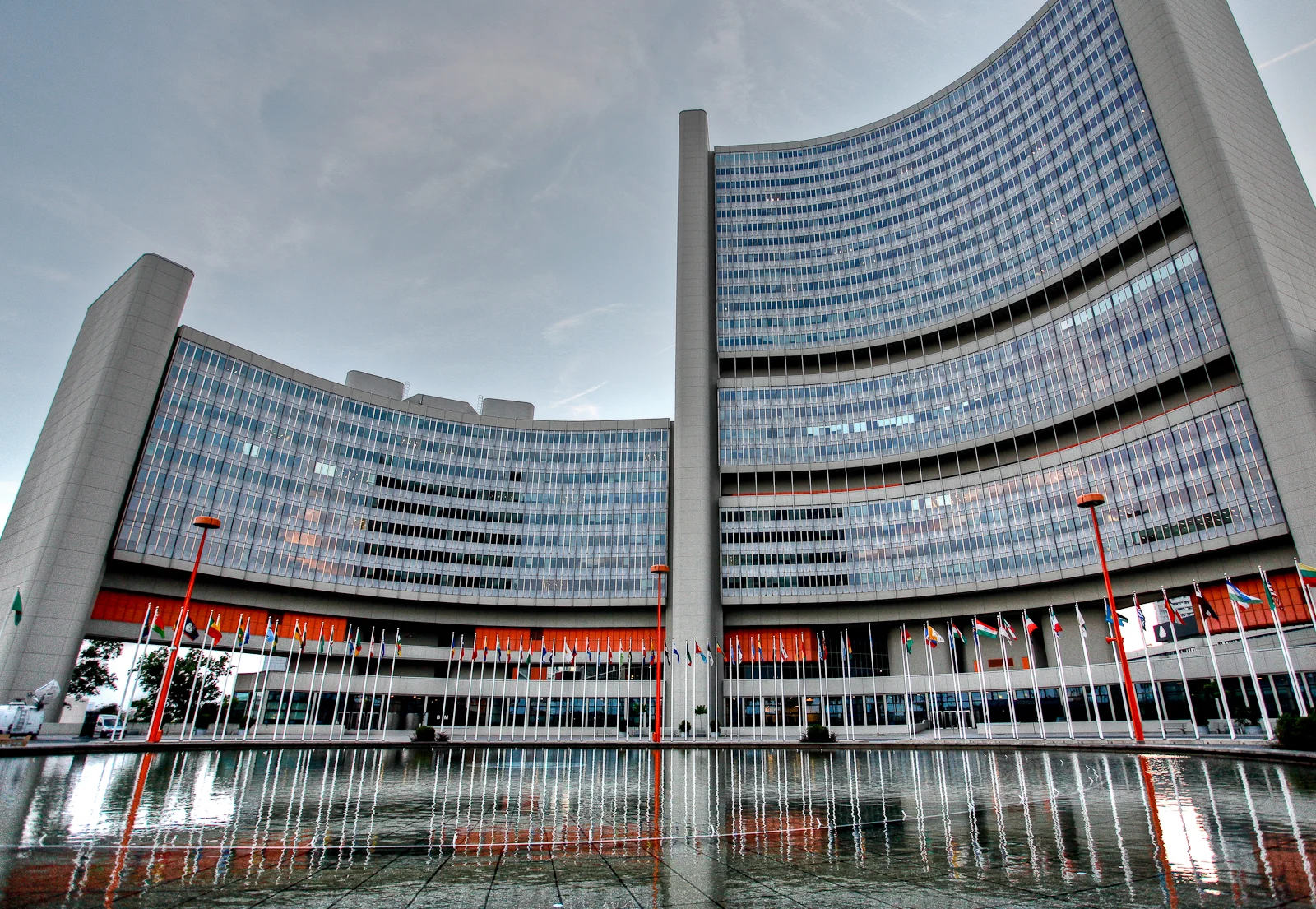
The IAEA (International Atomic Energy Agency) is the international body that promotes peaceful uses of nuclear energy and checks that nuclear material is not diverted to weapons. As the only international organisation able to monitor Iran’s nuclear programme on the ground, it sits at the centre of the dispute between Tehran and Western countries.
When and why was the IAEA founded?
The agency traces its origins to US President Dwight D. Eisenhower’s “Atoms for Peace” address, which proposed an international body to both promote and regulate peaceful nuclear power. Its statute, negotiated by twelve countries between 1955 and 1957, was approved on 23 October 1956 and entered into force on 29 July 1957 upon US ratification. Its three main missions are peaceful uses, safeguards and nuclear safety. The IAEA and its then Director General Mohamed ElBaradei shared the 2005 Nobel Peace Prize.
Where is it based and how many members does it have?
Its headquarters are at the UN office in Vienna. It runs laboratories in Seibersdorf (Austria), Monaco and Trieste (Italy), regional safeguards offices in Toronto and Tokyo, and liaison offices in New York and Geneva. English Wikipedia puts membership at 182 states, Turkish Wikipedia at 175. Joining the Nuclear Non-Proliferation Treaty (NPT) is not a precondition for membership. The IAEA is an autonomous organisation within the UN system, governed by its own treaty, and reports to both the General Assembly and the Security Council.
How is it governed?
The General Conference of all members, one vote each, meets every year, usually in September. Key decisions are taken by the 35-member Board of Governors, which meets about five times a year; according to Wikipedia, 22 members are elected by the General Conference and at least 10 are designated by the outgoing Board. The Secretariat is headed by the Director General. Rafael Grossi of Argentina has held the post since 3 December 2019, the first Latin American to do so, after Yukiya Amano (2009-2019) and ElBaradei (1997-2009).
What are safeguards?
Safeguards are the inspection system that verifies nuclear material is used only for peaceful purposes. The NPT, in force since 1970, requires non-nuclear-weapon states to conclude comprehensive safeguards agreements with the IAEA. Inspectors verify facility design information, carry out routine and ad hoc inspections and count nuclear material inventories. The agency prepares an annual implementation report for each country and presents it to the Board’s June meeting.
What is the Additional Protocol?
The Additional Protocol is a model agreement approved by the Board in 1997 to strengthen inspections. A state that signs it reports more widely, including on research and uranium production; inspectors can visit suspect locations at short notice (for example two hours), take environmental samples and use remote monitoring. According to Wikipedia, 144 countries had an Additional Protocol in force as of 31 December 2025.
How long has the IAEA been inspecting Iran?
Iran was among the original parties to the NPT when it entered into force in 1970, so its facilities are subject to IAEA safeguards. The file took shape in 2002: in August that year the opposition National Council of Resistance of Iran exposed undeclared sites at Natanz and Arak. Under the October 2003 Tehran Agreement, Iran committed to sign the Additional Protocol. In September 2005 the Board found Iran in non-compliance with its safeguards, after which Iran stopped implementing the protocol voluntarily. The UN Security Council adopted Resolution 1696 in July 2006.
What changed under the nuclear deal?
The Joint Comprehensive Plan of Action (JCPOA), reached on 14 July 2015, gave verification to the IAEA, which confirmed Iranian compliance on “Implementation Day”, 16 January 2016. The US withdrew from the deal in 2018. In July 2019 the IAEA confirmed Iran had exceeded the 300 kg stockpile limit and the 3.67% enrichment cap. Iran began enriching to 60% in April 2021, and in February 2023 the agency reported finding uranium particles enriched to 84%.
What has happened to inspections since 2025?
On 12 June 2025 the Board found Iran in non-compliance for the first time in 20 years. According to Wikipedia, the IAEA then estimated Iran’s 60% stockpile at 440.9 kg. The next day Israel, and later the US, struck Iranian nuclear sites; Iran suspended cooperation in early July and inspectors had left by 4 July. In September 2026 the Board again reported Iran to the UN Security Council. On 18 November in Vienna, Grossi said the agency had received no information on declared facilities other than Bushehr and had lost “continuity of knowledge” over the 60% stockpile. Tehran considers the agency biased: on 15 November Foreign Ministry spokesman Esmaeil Baghaei accused it of acting under US and European influence.
Why it matters
IAEA reports underpin the diplomatic and legal steps in the Iran file: referrals to the Security Council, sanctions and the inspection terms of any new agreement all depend on the agency’s findings. Without inspectors on the ground, no one can independently say where Iran’s highly enriched uranium is or how much of it exists. That uncertainty affects both the military tension and the negotiations, and whether inspectors return to Iran is one of the main questions that will shape the nuclear file in the period ahead.
Source: Vikipedi (İngilizce), International Atomic Energy Agency, Vikipedi (İngilizce), IAEA safeguards, Vikipedi (İngilizce), Nuclear program of Iran, Vikipedi (Türkçe), Uluslararası Atom Enerjisi Ajansı · Image: IAEA Imagebank, CC BY-SA 2.0