
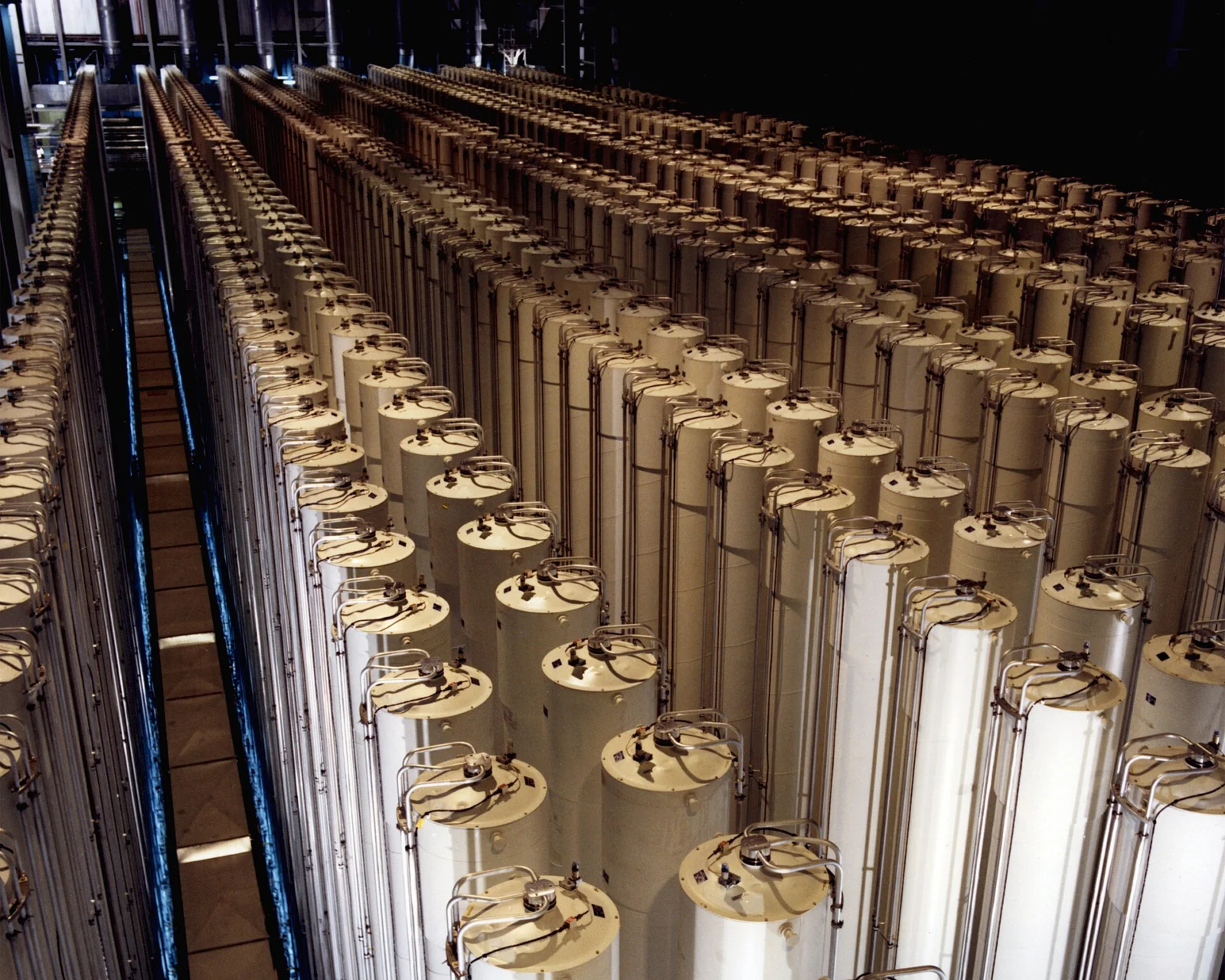
Uranium enrichment is the process of raising the share of the fissile isotope uranium-235 in natural uranium. Because the same technology can produce both fuel for power plants and material for nuclear weapons, it sits at the centre of the dispute over Iran’s nuclear programme.
What does uranium enrichment mean?
Mined uranium consists mostly of two isotopes: about 99.3% is uranium-238 and only around 0.7% is uranium-235. The chain reaction that produces energy in a reactor comes mainly from splitting uranium-235 atoms. The two isotopes are chemically identical; the only difference is that the uranium-238 nucleus has three more neutrons. Enrichment exploits this small difference in mass to raise the proportion of uranium-235. The leftover material, poorer in uranium-235, is called depleted uranium.
How is uranium enriched?
Ore is first milled into “yellowcake”, an oxide that is roughly 80% uranium. Because enrichment is done with a gas, the oxide is converted at a separate plant into uranium hexafluoride (UF6). Today almost all commercial enrichment uses gas centrifuges: in fast-spinning cylinders the heavier molecules are pushed towards the wall while the lighter ones containing uranium-235 gather near the centre. A single centrifuge achieves only a tiny separation, so thousands of machines are linked in series known as cascades. The older gaseous diffusion method was abandoned because it used so much energy; the last large commercial plant of that kind, Paducah in the United States, stopped enriching in 2013.
3.67%, 20%, 90%: what do the enrichment levels mean?
Light-water reactors, which make up most of the world’s power plants, use fuel enriched to between 3% and 5%. Uranium below 20% is called low-enriched uranium; 20% and above is highly enriched uranium. The 5-20% range is used in some small modular reactor designs and in research reactors; the Tehran Research Reactor has run on 19.75% fuel since 1987. Sources give different thresholds for weapons: English Wikipedia says nuclear weapons usually use 85% or more, while the World Nuclear Association (WNA) says weapons require at least 90%. The bomb dropped on Hiroshima in 1945 contained 64 kilograms of uranium enriched to about 80%.
Which countries enrich uranium?
According to Wikipedia, the countries known to operate enrichment facilities are Argentina, Brazil, China, France, Germany, India, Iran, Japan, the Netherlands, North Korea, Pakistan, Russia, the United Kingdom and the United States. The WNA lists three major commercial suppliers: France’s Orano, Russia’s Rosatom and the European Urenco, with China’s CNNC a major domestic supplier. The WNA describes enrichment as a sensitive technology that needs tight international control from a non-proliferation standpoint. The process can also run in reverse: under the US-Russian “Megatons to Megawatts” programme, 250 tonnes of highly enriched uranium were downblended into power-plant fuel between 1995 and 2005.
Since when has Iran enriched to 60%?
The 2015 nuclear deal (JCPOA) capped Iran’s enrichment at 3.67% for 15 years and its stockpile at 300 kg. The US withdrew in 2018, and in July 2019 the IAEA confirmed Iran had breached both limits. In April 2021, after a sabotage attack on the Natanz plant, Iran began producing 60% enriched uranium, a level it had never reached before, first at Natanz and later at Fordow. On 31 May 2025 the IAEA reported that the 60% stockpile had passed 408 kg, a rise of nearly 50% since February. The agency’s estimate in June 2025 was 440.9 kg.
Why is 60% so contested?
Sixty per cent is far above fuel-grade enrichment and close to weapons grade. In its May 2025 report the IAEA said the amount would be enough for several weapons if enriched further, noted that Iran is the only non-nuclear-weapon state producing such material and called the situation a “serious concern”. According to a report by the Italian think tank ISPI cited by Wikipedia, sources in Tehran claimed the existing 441 kg stockpile could be raised to 90% within weeks using advanced centrifuges; the claim has not been independently verified. Iran says its programme is peaceful and that its right to civilian enrichment is legally protected.
Where is the stockpile now?
The war of June 2025 and the US-Israeli strikes of February 2026 targeted Natanz and Fordow, and Iran suspended cooperation with inspectors. On 18 November IAEA Director General Rafael Grossi said the agency had lost “continuity of knowledge” over the 60% stockpile. In talks that began after a Pakistan-mediated ceasefire in April 2026, the US is demanding a complete and permanent end to enrichment while Iran refuses to give up that right, and mediation efforts are continuing.
Why it matters
The enrichment level is the basic measure of whether a nuclear programme can produce power-plant fuel or weapons material. In the Iran file, every negotiation, sanctions decision and military threat revolves around this percentage and the size of the stockpile. With no inspectors on the ground, no one knows where the 60% uranium is or in what condition; whether a possible agreement allows zero or limited enrichment is one of the main questions that will shape tensions in the region.
Source: Vikipedi (İngilizce), Enriched uranium, Vikipedi (İngilizce), Nuclear program of Iran, Vikipedi (İngilizce), Gas centrifuge, World Nuclear Association, Uranium Enrichment · Image: U.S. Department of Energy, Public domain