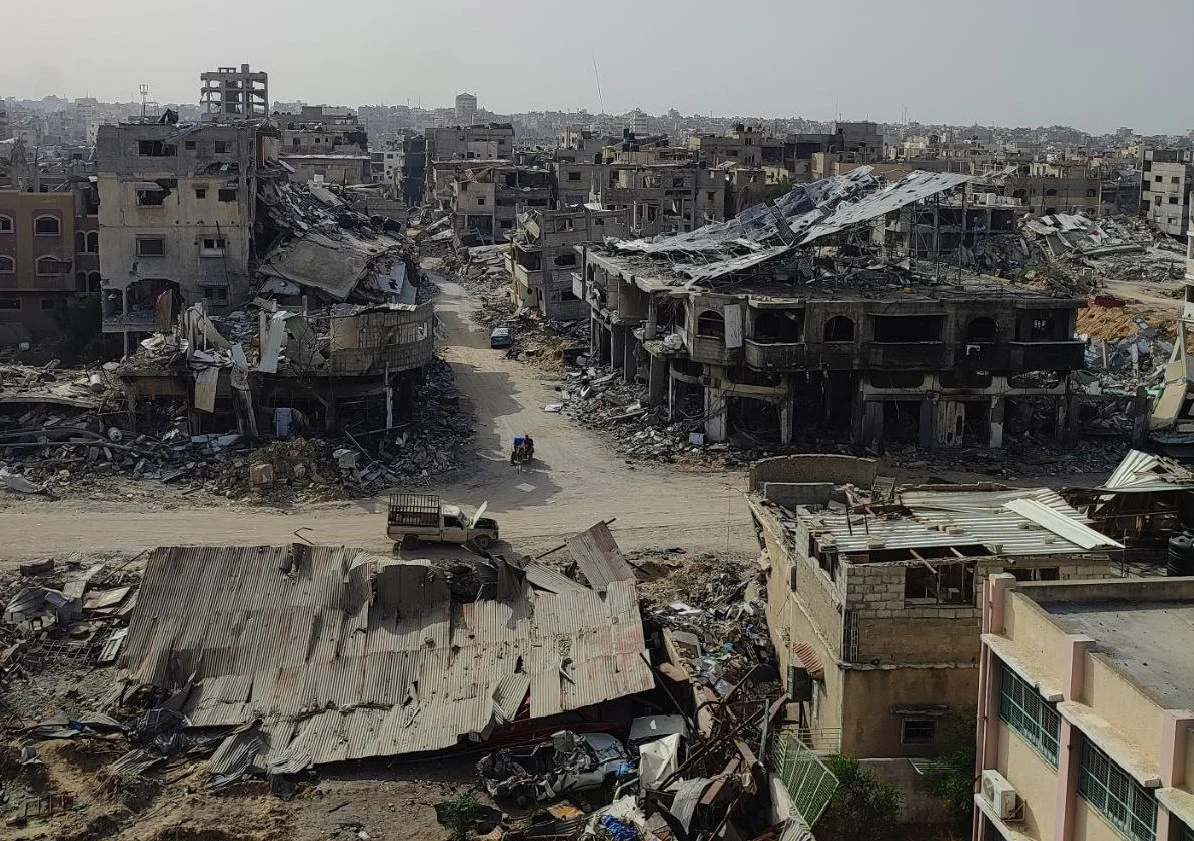
Israel’s military assault on Gaza has made the territory’s air, soil and water dangerous for decades to come, the aid group Oxfam and the Conflict and Environment Observatory (CEOBS) said in a report released on Monday, finding indicators of potential contamination across more than 99 per cent of the Strip.
The report, titled “Environmental War Crimes”, draws on satellite imagery, remote sensing and open-source data. It says the scale of the bombardment has affected about 78 per cent of Gaza’s land area. Heavy metals, explosive residues, asbestos from destroyed buildings, dioxins and biological contaminants now threaten the water and soil systems people depend on to survive. The highest risks are concentrated in Gaza City, Khan Younis, Rafah, Jabalia and along the Salah al-Din Road.
Among the starkest findings is the state of groundwater. Faecal coliforms were found in 19 per cent of 79 wells sampled across Gaza in July 2026, compared with 2 per cent in 2021. Only 19 per cent of sewage pumping stations still work and just 30 per cent of the wastewater network has some capacity. As a result, around 40,000 cubic metres of raw sewage flows into the Mediterranean every day, with another 15,000 cubic metres a day leaking into the ground through cesspits and other pathways.
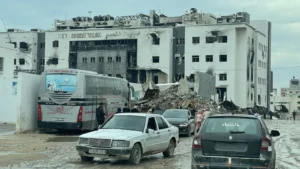
Clay-rich soils around Beit Hanoun, Wadi Gaza and north-east of Khan Younis are more likely to retain pollutants, threatening food crops once farming resumes, the report says. Gaza City, Jabalia and North Gaza face the highest risk of air contamination as dust from the bombardment is stirred up again by wind, traffic and debris clearance. The UN Environment Programme estimates that more than 61 million tonnes of debris have accumulated in the territory.
Oxfam International Executive Director Amitabh Behar said people in Gaza are exposed to toxins through air, food, water and direct contact with contaminated soil and rubble, and that the risks will persist for generations without clean-up and remediation. Children and pregnant women face the highest risks, he added. Oxfam said the full extent of the contamination cannot be measured because Israel has refused independent access for an on-the-ground assessment and blocked testing equipment and experts. The group described the assault as “environmental war crimes” and “genocide”; Israel has not yet commented on the report.
Background
According to figures cited by Oxfam, more than 74,000 Palestinians had been killed and over 175,000 wounded in Gaza by November 2026. The UN reported in early 2026 that more than 200,000 tonnes of explosives had been dropped on Gaza in almost two years. Oxfam says discussions on recovery and reconstruction are moving ahead without a field-level environmental assessment.
Source: Oxfam (ReliefWeb) · Image: Rawanmurad2025, CC BY-SA 4.0