Iran’s head of state is the supreme leader, styled in the constitution as “leader of the Islamic Revolution”; the president is head of government and the country’s second-highest official. The armed forces, judiciary, state broadcaster and the councils that oversee elections answer to the leader, while the president runs the government’s day-to-day business.
How did the office of supreme leader come about?
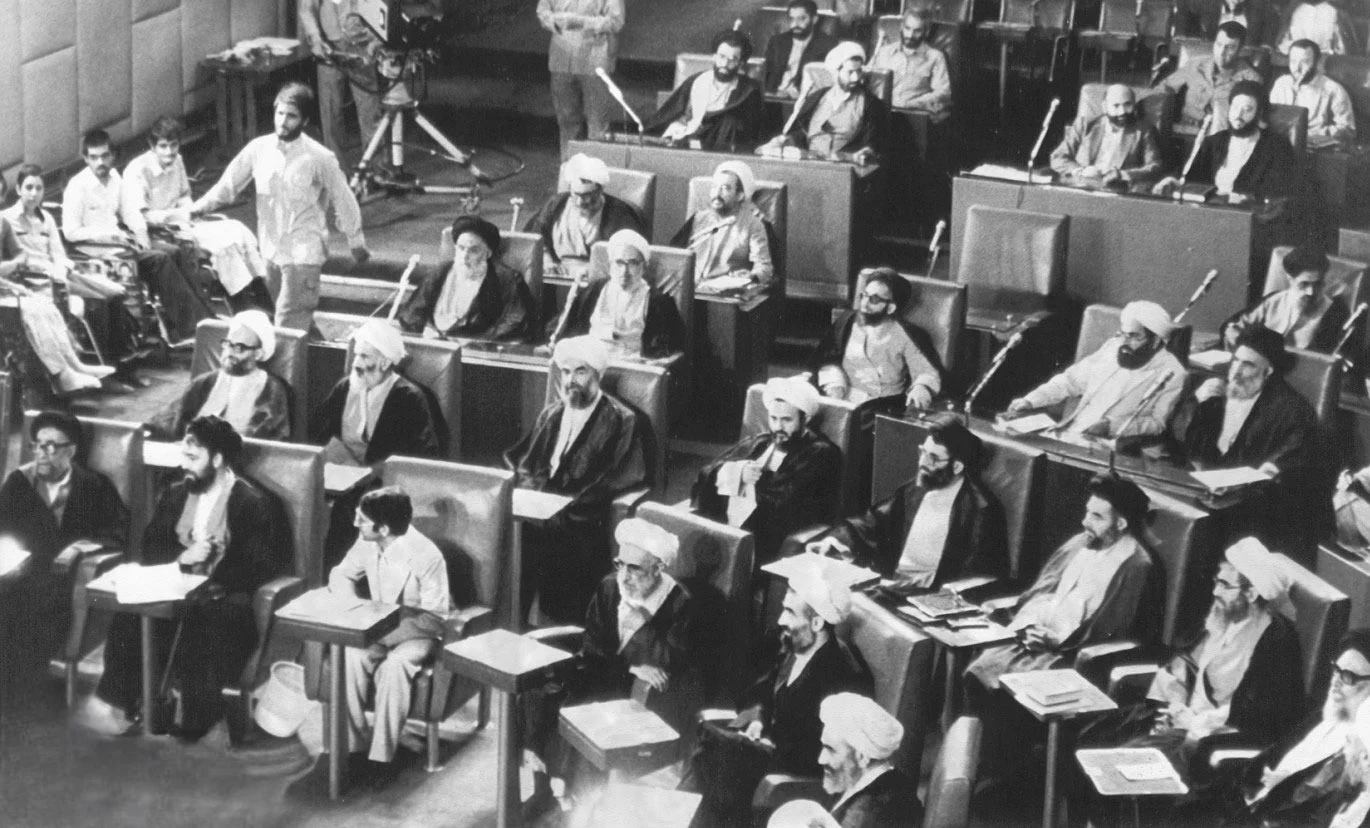
The office was created by the constitution drafted after the 1979 revolution. It rests on Ayatollah Ruhollah Khomeini’s concept of velayat-e faqih, the guardianship of the Islamic jurist, which holds that in the absence of the twelfth Imam the community should be led by the most learned jurist. In the March 1979 referendum on an “Islamic Republic”, 98% of those voting said yes; the new constitution was approved by another referendum in the first week of December 1979.
Who has held the post?
The Islamic Republic has had three supreme leaders. Khomeini served from 1979 until his death in 1989. He was succeeded by Ali Khamenei, then the president. Khamenei was killed in the strikes of 28 February 2026 that started the 2026 Iran war. The Assembly of Experts met from 3 to 8 March 2026 and on 9 March named his son, Mojtaba Khamenei, as the new leader. Mojtaba Khamenei has not appeared in public since taking office; in October the judiciary said he had met its head, Gholam-Hossein Mohseni-Eje’i.
Who chooses the supreme leader?
Under Article 111 of the constitution, the Assembly of Experts elects, supervises and can dismiss the leader. Its 88 members are elected by the public for eight-year terms, but candidates must first be approved by the Guardian Council. In 2016 only 166 of 801 applicants were allowed to run. The leader serves for life. According to Wikipedia, the assembly has never openly challenged any of the leader’s decisions, and its meetings and records are confidential. If the leader dies or is removed, an interim council of the president, the chief justice and a jurist from the Guardian Council takes over. This provision was used for the first time in 2026, with President Masoud Pezeshkian, Gholam-Hossein Mohseni-Eje’i and Alireza Arafi on the council.
What powers does the supreme leader have?
Under Articles 57 and 110, the leader supervises the legislative, executive and judicial branches and sets the general policies of the state. His main powers include:
- Command of the armed forces; declaring war and peace.
- Appointing and dismissing the head of the judiciary, the chief of staff, the top military commanders and the head of state radio and television.
- Directly appointing six clerics to the 12-member Guardian Council.
- Appointing members of the Expediency Discernment Council and calling referendums.
- Endorsing the elected president and, under certain conditions, dismissing him.
The leader can also dismiss and reinstate ministers. Sources say the ministers of defence, intelligence and foreign affairs are chosen with his approval; one page adds the science ministry, another the interior and science ministries. According to Wikipedia, Iran’s regional policy is run directly by the leader’s office, and the Quds Force of the Revolutionary Guards, which reports to the leader, chooses Iran’s ambassadors to Arab countries. The leader receives no salary and is legally considered “inviolable”.
How is the president elected?
The president is elected by voters aged 18 and over for a four-year term and can serve at most two consecutive terms. If no candidate wins a simple majority in the first round, the top two go to a runoff. Candidates are vetted by the Guardian Council: in 1997, for example, only four of 238 applicants were approved. The winner is endorsed by a decree of the supreme leader and then sworn in before parliament. The current president, Masoud Pezeshkian, won the July 2024 runoff held after Ebrahim Raisi died in a helicopter crash on 19 May 2024, and was appointed on 28 July 2024.
What powers does the president have?
The president chairs the cabinet, nominates ministers for parliamentary approval, appoints vice presidents and heads the Supreme National Security Council and the Supreme Council of the Cultural Revolution. He receives foreign ambassadors, signs treaties and laws approved by parliament, and oversees budget and planning. The UN lists the president as Iran’s head of state. All these powers, however, are subject to the leader’s supervision and approval, and decisions of the Supreme National Security Council take effect once the leader confirms them.
How has the presidency changed?
The first presidential election was held in January 1980 and won by Abolhassan Banisadr, who was impeached by parliament in June 1981. Under the 1979 constitution the presidency was largely ceremonial, with real executive power held by the prime minister. A 1989 amendment abolished the post of prime minister and transferred its powers to the president. The same amendment dropped the requirement that the leader be a marja, a top-ranking source of religious emulation.
Why does the Guardian Council matter so much?
The leader directly appoints the council’s six clerics; the other six jurists are nominated by the leader-appointed head of the judiciary and approved by parliament. The council reviews every law passed by parliament for compliance with Islamic law and the constitution, supervises elections, and approves or rejects candidates for the presidency, parliament and the Assembly of Experts. As a result, even the candidates for the body that chooses the leader are indirectly screened by the leader’s appointees. Western observers argue that the system shuts out reformist candidates; the council rejects this, citing reformists it has approved in several elections.
Source: Vikipedi (İngilizce), Supreme Leader of Iran, Vikipedi (İngilizce), President of Iran, Vikipedi (İngilizce), Assembly of Experts, Vikipedi (İngilizce), Guardian Council, Vikipedi (İngilizce), 2026 Iranian supreme leader election · Image: Unknown, Public domain