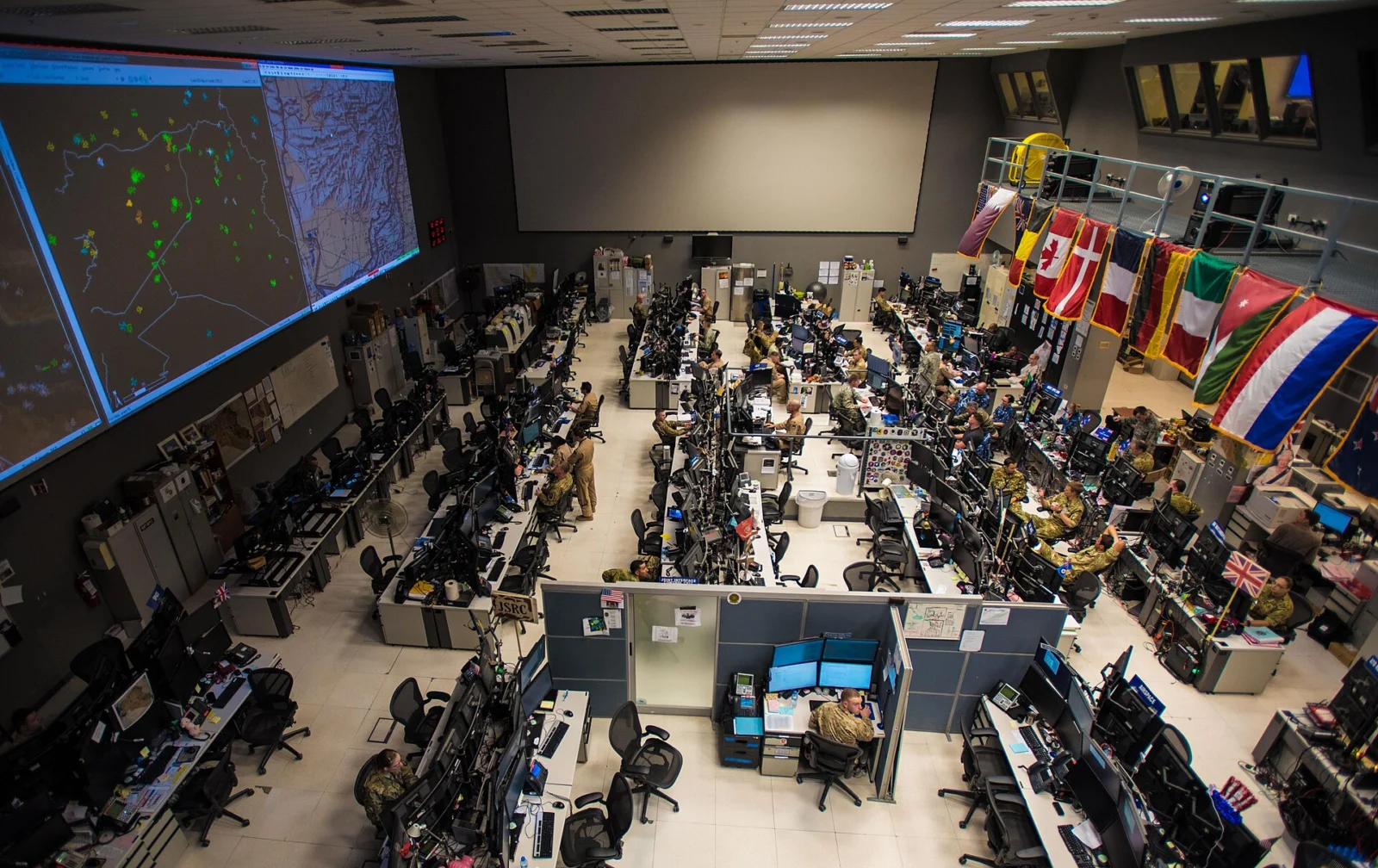
CENTCOM, the United States Central Command, is the US Department of Defense’s regional unified command responsible for the Middle East, Central Asia and part of South Asia. America’s Gulf bases, naval forces and military operations in the region all fall under its authority.
When and why was CENTCOM founded?
The command grew out of the Rapid Deployment Joint Task Force (RDJTF), which President Jimmy Carter set up in March 1980. The task force was first part of US Readiness Command and was later made independent. CENTCOM was established on 1 January 1983 and took over its responsibilities. Its motto is “Persistent Excellence”.
Where is its headquarters?
The main headquarters is at MacDill Air Force Base in Tampa, Florida. CENTCOM is one of four regional commands headquartered outside their own area of responsibility, alongside AFRICOM, SOUTHCOM and SPACECOM. In the region, a forward headquarters was set up in 2002 at Camp As Sayliyah in Doha, Qatar, and moved in 2009 to Al Udeid Air Base, also in Qatar.
Which countries does it cover?
According to English Wikipedia, CENTCOM’s area of responsibility includes 21 countries: Afghanistan, Bahrain, Egypt, Iran, Iraq, Israel, Jordan, Kazakhstan, Kuwait, Kyrgyzstan, Lebanon, Oman, Pakistan, Qatar, Saudi Arabia, Syria, Tajikistan, Turkmenistan, the United Arab Emirates, Uzbekistan and Yemen. Israel became the 21st on 15 January 2021, when it was moved from European Command (EUCOM). Sudan, Eritrea, Ethiopia, Djibouti, Kenya and Somalia were transferred to the new Africa Command on 1 October 2008, while Egypt remained with CENTCOM.
How is the command organised?
CENTCOM has a component command for each service. The Army component, ARCENT, and the Air Force component, AFCENT, are headquartered at Shaw Air Force Base in South Carolina. The naval component, NAVCENT, which also commands the US Fifth Fleet, is based at Naval Support Activity Bahrain. The Marine component MARFORCENT, Special Operations Command Central (SOCCENT) and the space component SPACEFORCENT, created on 2 December 2022, are at MacDill.
Which bases does it have in the Middle East?
The largest US facilities in the region are concentrated in the Gulf. Wikipedia’s list of US military installations includes:
- Qatar: Al Udeid Air Base (shared with Qatar; CENTCOM’s forward headquarters).
- Bahrain: Naval Support Activity Bahrain (Fifth Fleet and NAVCENT).
- Kuwait: Camp Arifjan, Camp Buehring, Camp Patriot, Ahmad al-Jaber Air Base and Ali Al Salem Air Base.
- Saudi Arabia: Prince Sultan Air Base.
- United Arab Emirates: Al Dhafra Air Base.
- Jordan: Muwaffaq Salti Air Base (Azraq) and the Tower 22 outpost at Rukban.
US troops are also present in Iraq and Syria as part of Operation Inherent Resolve against ISIS; the list does not name separate facilities in those two countries.
Which wars has CENTCOM run?
Its first major test was Operation Desert Storm, launched on 17 January 1991; Kuwait was liberated from Iraqi occupation on 27 February 1991. After the 11 September 2001 attacks, CENTCOM ran Operation Enduring Freedom in Afghanistan and Operation Iraqi Freedom, which began with the invasion of Iraq on 19 March 2003. Operations against ISIS in Iraq and Syria have continued since 2014. According to Wikipedia, on 28 February 2026 CENTCOM led a joint US-Israeli operation against Iran, called “Epic Fury”, targeting Revolutionary Guards command centres, air defences, and missile and drone sites.
Who commands CENTCOM?
Admiral Brad Cooper of the US Navy has led the command since 8 August 2025, succeeding Michael Kurilla. Two former commanders, Jim Mattis and Lloyd Austin, later became US Secretary of Defense. In 2019 Iran designated CENTCOM a terrorist organisation after the US placed the Revolutionary Guards on its terrorism list.
Why it matters
CENTCOM is the single umbrella for America’s military presence in the Middle East: protecting shipping through the Strait of Hormuz and the Bab el-Mandeb, Gulf air defence and the ongoing war with Iran all fall under it. Many statements about the region also come from CENTCOM; most recently it denied an Iranian army claim to have hit a US F-16. The rise in the number of US aircraft carriers in the region to three also shows the growing force at its disposal. Because Gulf bases underpin US deterrence and are also seen as potential targets in times of conflict, the security of host countries is directly tied to this structure.
Source: Vikipedi (İngilizce), United States Central Command, Vikipedi (İngilizce), List of American military installations · Image: U.S. Air Force photo by Staff Sgt. Alexander W. Riedel, Public domain