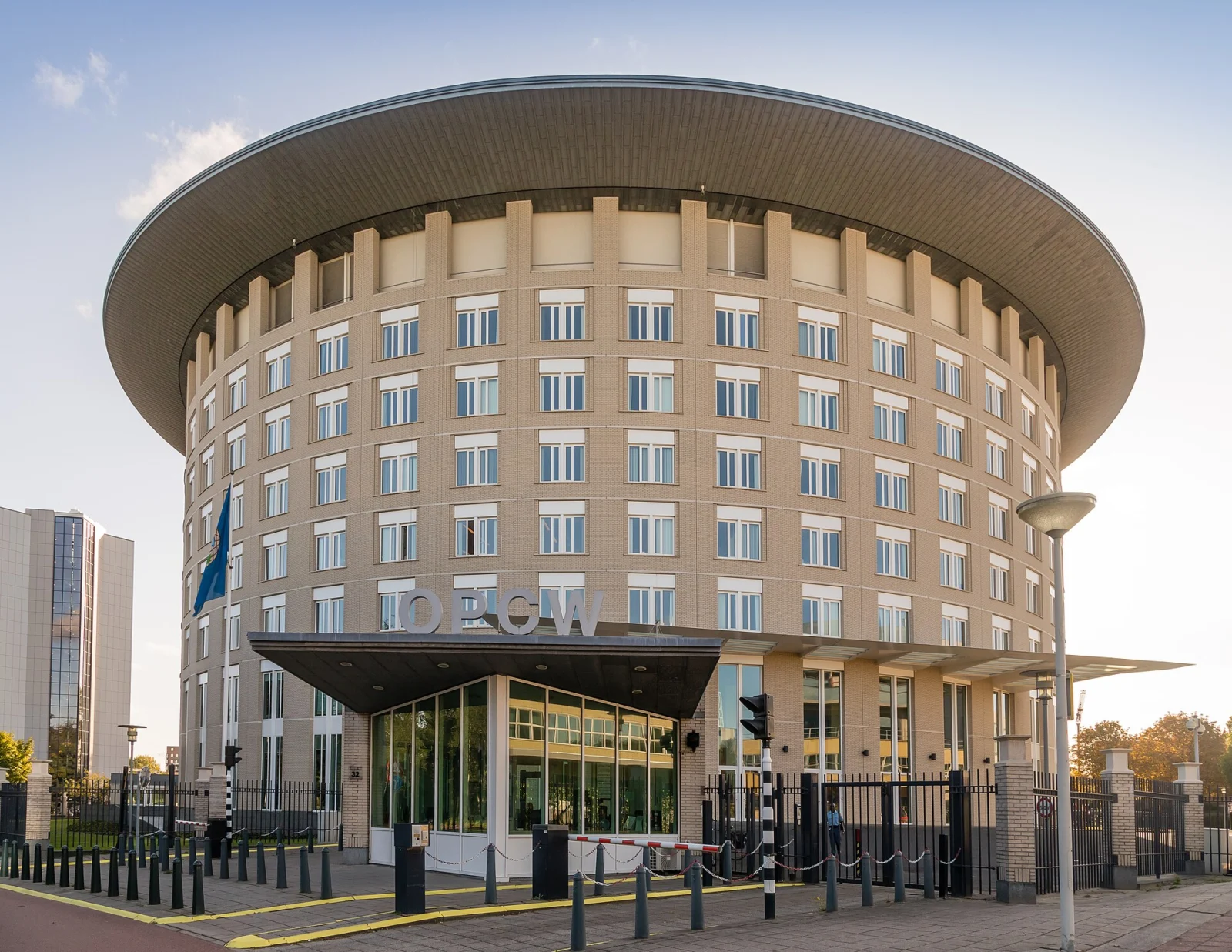
The Organisation for the Prohibition of Chemical Weapons (OPCW) says only 7 of 26 outstanding issues stemming from Syria’s 2013 initial declaration have been resolved, and that the remaining 19 include potentially large quantities of undeclared or unverified chemical warfare agents and munitions.
The Director-General’s report, dated 24 November, is the organisation’s 158th monthly report on Syria and covers the period from 24 October to 23 November. According to the report, a team from the OPCW Technical Secretariat visited three priority sites in Syria between 2 and 11 November. The team identified equipment of potential relevance to the Assad-era programme and collected 12 samples, which will be sent to OPCW designated laboratories for analysis. The Secretariat is assessing whether the equipment was used to produce or use chemical weapons.
The report says an initial inspection was carried out in October at the second of two newly declared chemical weapons storage facilities, and that the amended declaration for that facility was verified. Syria amended its initial declaration in June after previously undeclared chemical weapons were jointly discovered in May 2026. The OPCW then verified the destruction of Category 3 chemical weapons, the first destruction of chemical weapons in Syria since 2014. Documents under analysis appear to contain information relevant to closing at least one outstanding issue.
Work on allegations of use is also continuing. A team conducted interviews in Syria from 22 to 31 October about one alleged chemical weapons incident, and the organisation is still investigating who carried out the 2014 chlorine attacks in Al-Tamanah and Kafr Zeita. The OPCW said funding commitments for its Syria activities total EUR 21.99 million for 2026 and 2027 and that, based on current information, no additional funding is projected to be needed.
Syria’s Minister of Emergency and Disaster Management, Raed al-Saleh, addressed the 31st session of the Conference of the States Parties in The Hague on 23 November and met the Director-General the same day. At the same conference, Jordan was elected to the OPCW Executive Council for the 2027–2029 term, Jordan’s official news agency Petra reported. Foreign Ministry spokesperson Fuad Majali said the result reflected the kingdom’s standing in multilateral diplomacy.
Background
Syria joined the Chemical Weapons Convention on 14 September 2013, and the treaty entered into force for the country on 14 October 2013. According to the OPCW, the initial declaration submitted by the Assad government on 23 October 2013 still could not be considered accurate and complete when the government changed in December 2024. The organisation is now working with the new Syrian authorities to locate remnants of the programme and has returned large quantities of scanned documents to them.
Source: OPCW Genel Direktör Raporu (ReliefWeb), Petra · Image: CEphoto, Uwe Aranas, CC BY-SA 4.0