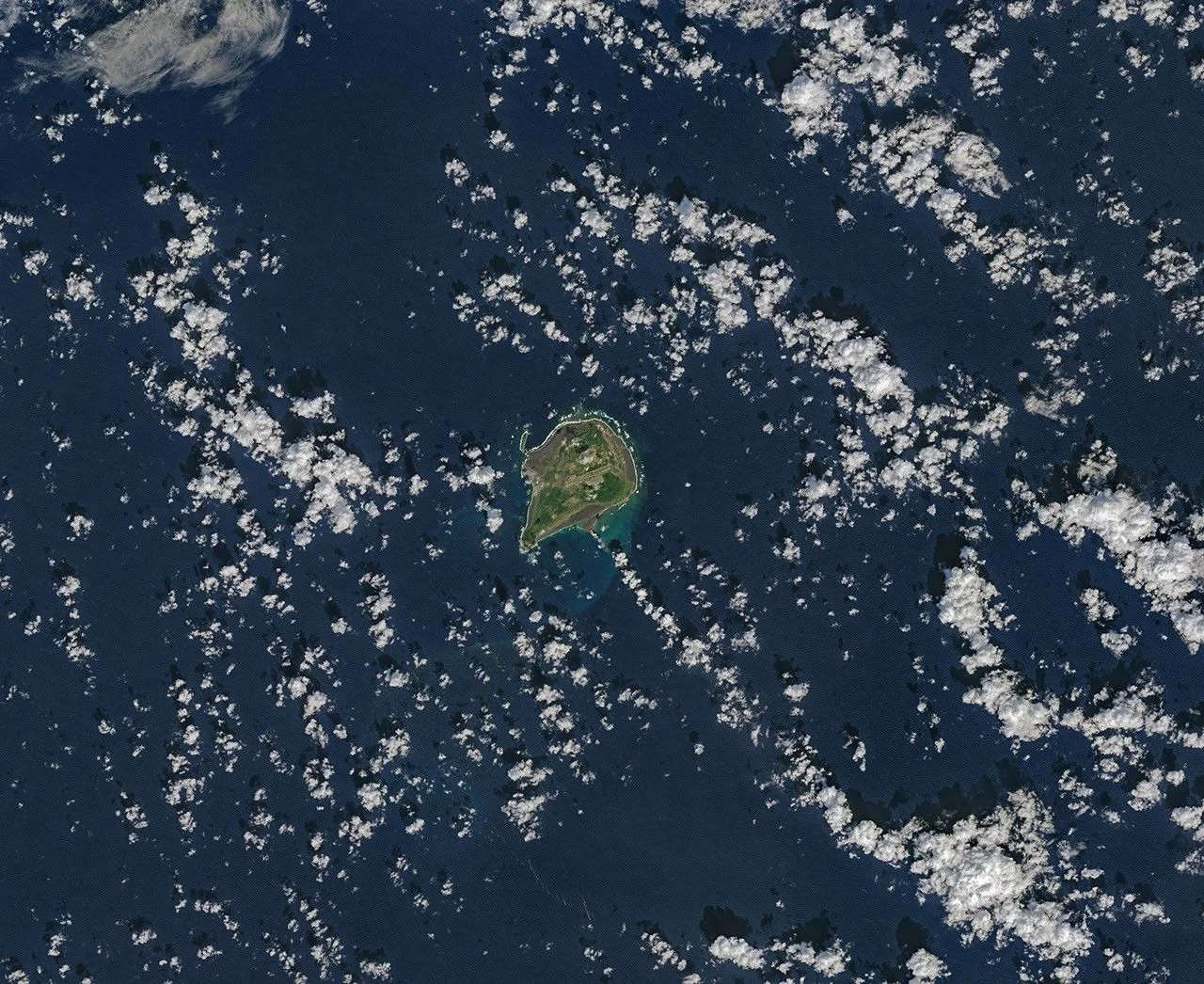
A volcanic eruption in the shallow waters off Iwo Jima’s southeast coast has extended the Japanese island’s famed black sand beaches, at least for now. Satellite images released by NASA Earth Observatory on 24 November show the eruption has added roughly 50 hectares of new beach.
According to NASA, signs of unrest began in late October. On 27 October, seismic sensors recorded a sharp rise in activity, and the Japan Meteorological Agency reported that the first photographs of the eruption had been taken. Landsat 9 captured the coast while it was still quiet on 26 October and got its first clear view of the new land on 11 November, showing the eruption’s heat signature, a faint gray plume drifting southeast and a streak of floating pumice.
The NASA-ISRO radar satellite NISAR had detected a large disturbance in the water through heavy cloud cover on 28 October, in the same area that erupted in December 2023. Japan’s Coast Guard confirmed on 16 November that new land had formed, connected to the existing beach. NASA says the addition enlarges the island by about 1.7%. The new land adjoins the southeast beach where American troops landed on 19 February 1945.
Daniel Slayback, a scientist at NASA’s Goddard Space Flight Center, said land created by the 2023 eruption was washed away by waves within a few weeks. “I imagine we’ll see this new land wash away within a few months,” he said. “But we’ll have to wait and see.” Goddard chief scientist James Garvin said that if basaltic-andesitic lava is injected into the new material, it could cement the ash and the land could follow a different pattern than in 2023.
Background
Iwo Jima has seen repeated submarine eruptions in recent years, including one off its southeast coast in 2023 and another off its west coast in August 2025. The island is known as the site of one of the bloodiest battles in the history of the U.S. Marines during the Second World War. NASA continues to monitor the site with NISAR radar data and sub-meter commercial satellite imagery.
Source: NASA Earth Observatory · Image: NASA Earth Observatory/Michala Garrison, Public domain