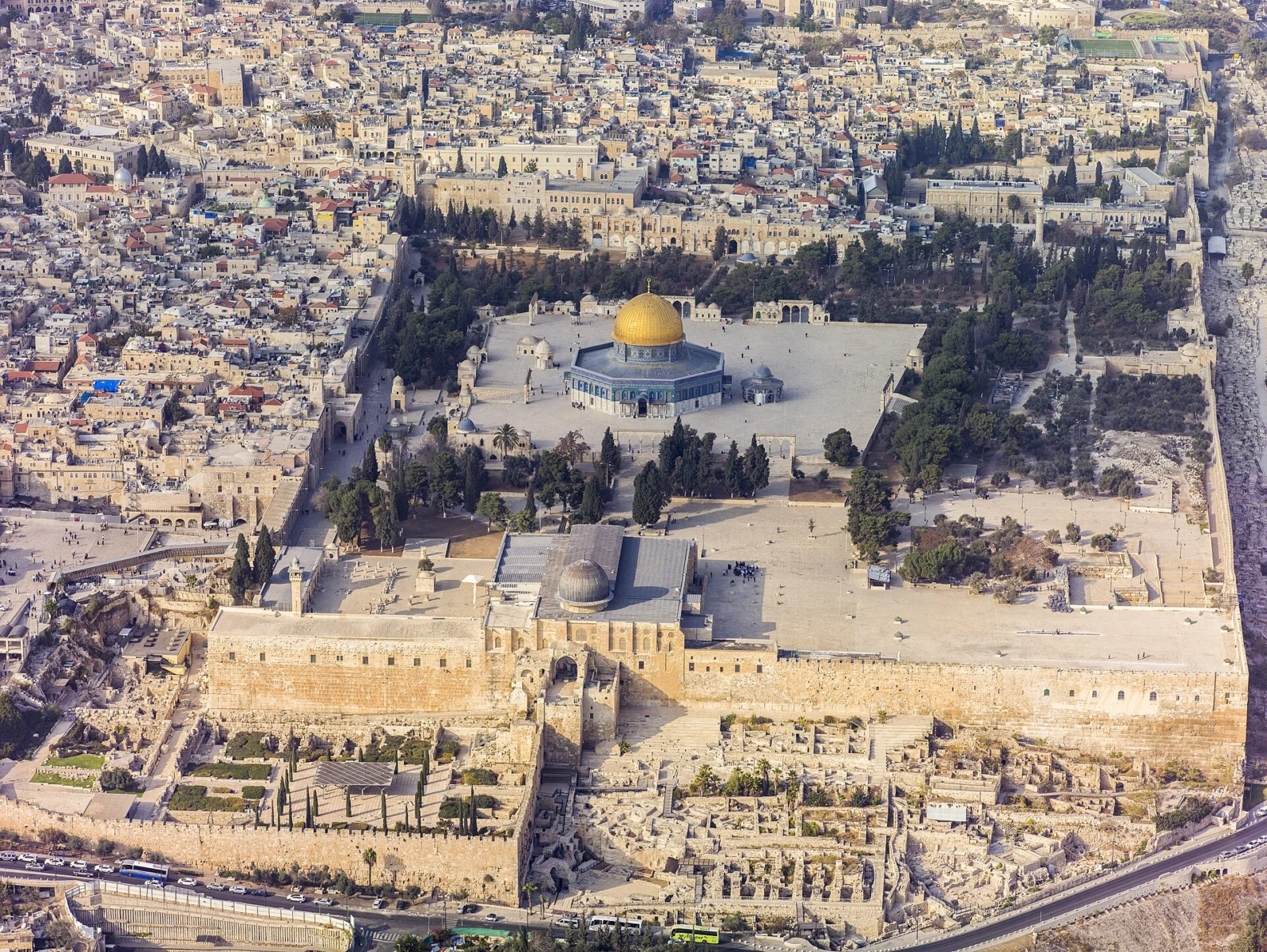
Al-Aqsa, also known as the Haram al-Sharif, is the compound in Jerusalem’s Old City that includes the Dome of the Rock and the Qibli Mosque and is regarded as the third holiest site in Islam; Jews know the same hilltop as the Temple Mount, the holiest site in Judaism. Today the compound is administered by the Jordan-appointed Jerusalem Waqf while Israel controls access, and under the arrangement known as the “status quo” only Muslims may pray there.
Where is Al-Aqsa and how big is it?
The compound sits on a trapezium-shaped platform in the eastern part of the Old City. According to English Wikipedia, the platform measures 488 metres along the west, 470 along the east, 315 along the north and 280 along the south, covering about 150,000 square metres. Turkish sources give the area as 144 dunams. It contains the Dome of the Rock, the main congregational mosque on the southern wall (the Qibli Mosque), prayer halls, madrasas and four minarets. In Arabic, “al-Masjid al-Aqsa” can refer either to the whole compound or to the silver-domed mosque in its south, which is why the two are often confused in news reports.
What does the status quo mean?
The status quo is less a single written treaty than a set of arrangements built up over time that the parties say they uphold. In its current form the core rules are: the Waqf runs the compound, Israel handles security and controls entry, Muslims worship there, and Jews and Christians may enter as visitors but may not pray. The Jewish place of prayer remains the Western Wall, part of the compound’s western retaining wall.
How did the status quo take shape?
According to Wikipedia, the compound has been administered continuously as an Islamic waqf since Saladin’s reconquest of Jerusalem in 1187. Under the Ottomans, non-Muslim entry was banned outright for centuries; after the Tanzimat reforms of 1839, non-Muslims could enter with a special permit from the governor. During the British Mandate, the League of Nations charter barred Britain from interfering in the administration of purely Muslim holy places, and a 1934 order-in-council confirmed the religious status quo inherited from Ottoman times. After the 1948 war East Jerusalem came under Jordanian control and Jordan set up the present-day Jerusalem Waqf administration; Israeli Jews could not visit the site during this period.
What changed in 1967?
Israel captured the Old City on 7 June 1967, during the Six-Day War. According to Wikipedia, on 17 June 1967 a meeting at Al-Aqsa between Moshe Dayan and Jerusalem’s Muslim religious authorities set out the framework of today’s status quo: Jews could visit if they behaved respectfully but could not pray, “religious sovereignty” would stay with the Muslims and “overall sovereignty” would be Israeli. The Muslim representatives objected because they rejected Israel’s capture of Jerusalem altogether, while some Jewish religious figures, led by the army’s chief rabbi Shlomo Goren, also objected, arguing the site had been handed to the Muslims. Israel banned the flying of the Israeli flag over the compound and did not apply some of its laws on holy places there.
Who runs the compound today?
Day-to-day administration lies with the Jerusalem Waqf and Al-Aqsa Mosque Affairs Department, part of Jordan’s Ministry of Awqaf. Its staff are Jordanian government employees, and its 18-member council and director are appointed by Jordan. The director since 2005 has been Sheikh Azzam al-Khatib. In 2017 Jordan enlarged the council from 11 to 18 members and for the first time included Palestinian officials. The 1994 Israel-Jordan peace treaty refers to the Hashemite custodial role over the holy sites, and a 2013 agreement between Palestinian President Mahmoud Abbas and Jordan’s King Abdullah II recognised Jordan’s role as well. Religious authority on the site rests with the Grand Mufti of Jerusalem, appointed by the Palestinian side, while Israeli police control entry and external security.
Who can enter, and when?
According to Wikipedia, eleven gates are open to Muslims, while non-Muslims may enter only through the Moors’ Gate (Mughrabi Gate). Non-Muslim visitors are admitted from Sunday to Thursday for four hours a day, and they have not been allowed inside the mosques since the Second Intifada began in 2000. Palestinian residents of Jerusalem and Arab citizens of Israel can generally enter freely. West Bank Palestinians, however, can usually reach Jerusalem only on religious holidays and with a permit. Israel also imposes age limits at times of tension; according to Wikipedia, during Ramadan 2024 men under 55 and women under 50 living in the West Bank were not given prayer permits. The same source says that this year, during the Iran war, the compound was closed for 40 days and Eid al-Fitr prayers could not be held there for the first time since 1967. Most recently, on 20 November, tens of thousands of Palestinians attended Friday prayers under tight restrictions.
Why is the status quo constantly disputed?
Many Palestinians believe the status quo is under threat because right-wing Israeli groups press their demand for a right to pray at the site more often and more forcefully. Israeli governments have repeatedly said the status quo will not change. There is no consensus on the Jewish side either: Israel’s Chief Rabbinate has held since 1967 that Jewish law forbids Jews from entering the compound, while some national-religious rabbis encourage visits. Flashpoints have included opposition leader Ariel Sharon’s visit in 2000, after which the uprising that followed became known as the “Al-Aqsa Intifada”. Israeli National Security Minister Itamar Ben-Gvir’s visit on 3 January 2023 drew condemnation from Arab states, and in September this year Saudi Arabia condemned his entry to the compound on Yom Kippur as a clear violation.
Source: Vikipedi (İngilizce), Temple Mount, Vikipedi (İngilizce), Al-Aqsa, Vikipedi (İngilizce), Jerusalem Waqf, Vikipedi (İngilizce), Temple Mount entry restrictions, Vikipedi (Türkçe), Mescid-i Aksa · Image: Godot13, CC BY-SA 4.0