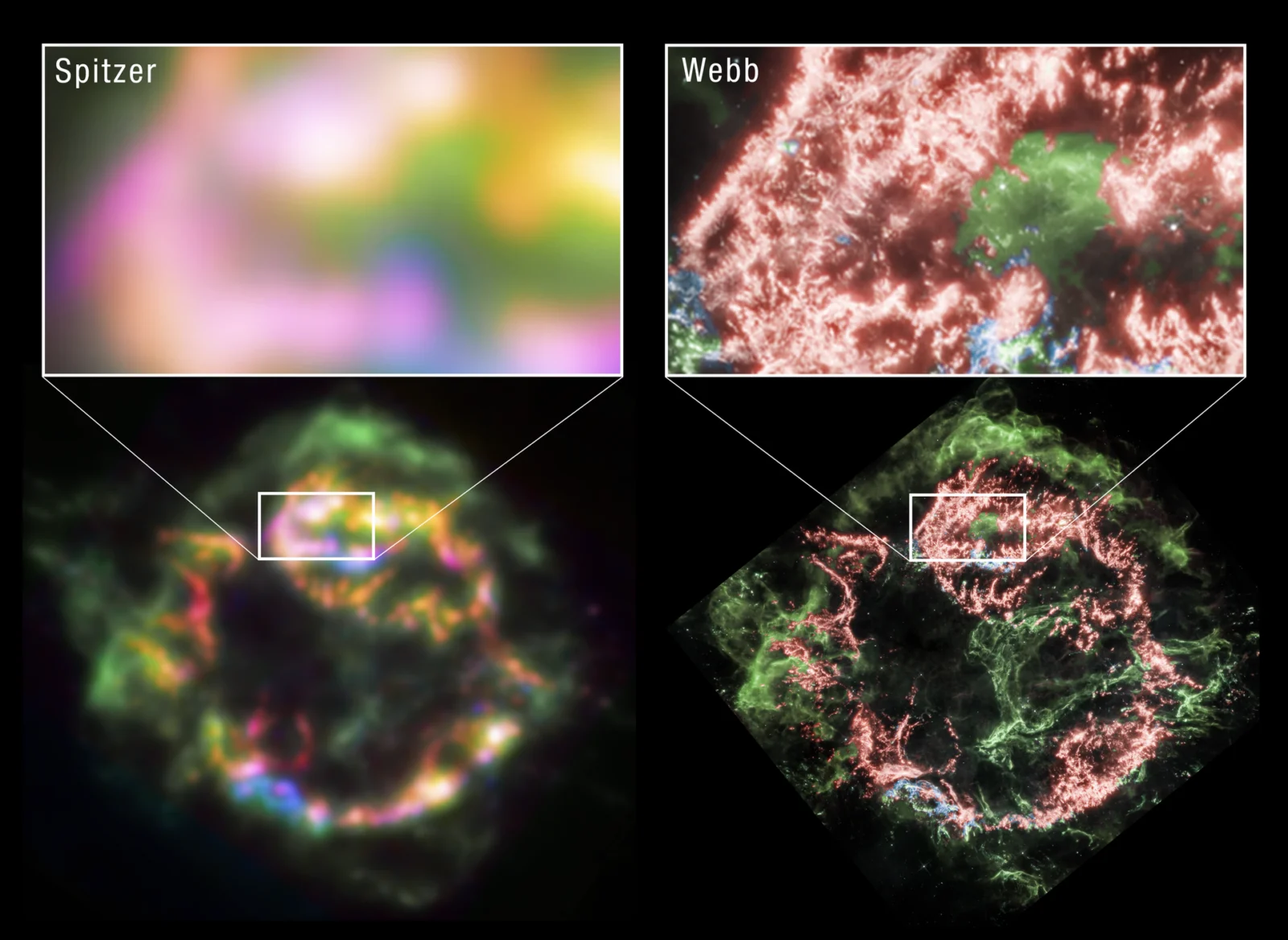
NASA’s James Webb Space Telescope has mapped the hot dust in the famous supernova remnant Cassiopeia A (Cas A) in high resolution. The composition of the dust supports a scenario in which the interior of the original star underwent a dramatic change, possibly just hours before it exploded. The results were published on Monday in The Astrophysical Journal Letters.
Supernova remnants are the clouds of gas and dust left after a massive star explodes, and their material eventually seeds new generations of stars and planets. Webb’s mid-infrared observation revealed new details about the structure and evolution of the star that produced Cas A.
According to NASA, as massive stars evolve, increasingly heavier elements fuse in their cores, stopping at iron, while lighter elements fuse in surrounding layers. This builds shells of elements that record the star’s history. When the star explodes, these elements are scattered into space, and some condense into dust grains that clump together. By studying the composition of these solar-system-sized clumps, Webb found evidence of a shell merger, in which layers inside a star mix before the explosion.
“Material within these shells churns and circulates, which can cause the shells to merge shortly before the supernova explosion,” said Tea Temim, the study’s lead author and a research scientist at Columbia University. She said a merger of the oxygen- and carbon-burning shells would significantly change the star’s structure and the chemical abundances seen after the explosion.
The team used data from NASA’s retired Spitzer Space Telescope to pick three targets. Two lay in the reverse-shocked region: one contained mostly silica dust, the other mostly carbon dust. The third was the “Green Monster”, a structure first discovered by Webb, rich in complex magnesium silicates and formed from material the star shed before exploding.
Background
Building on X-ray observations by NASA’s Chandra X-ray Observatory and the JAXA-led XRISM, Webb mapped the dust composition across the entire remnant. Together, the observations indicate the merger was under way very shortly before the explosion, and its signatures appear throughout much of the remnant. “We can tie the explosion back to the makeup of the progenitor star hundreds of years afterward,” said co-author Dan Milisavljevic of Purdue University. Webb is an international programme led by NASA with ESA and the Canadian Space Agency.
Source: NASA · Image: Image: NASA, ESA, CSA, STScI, Tea Temim (Columbia University), Rick Arendt (UMBC), Dan Mil, Public domain